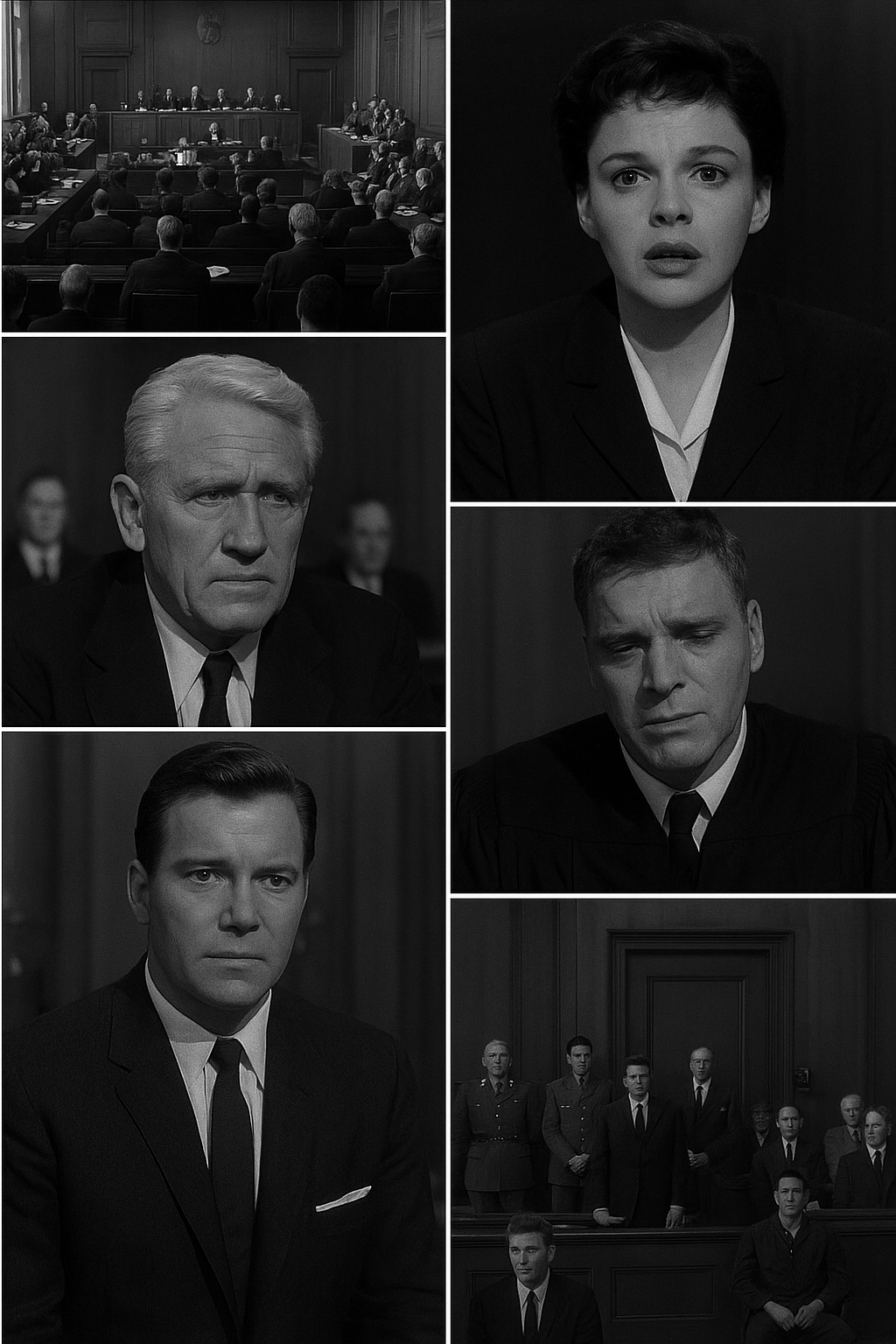
🎞️ Judgement at Nuremberg (1961):
Part 1: We Said ‘Never Again’…
Some films tell stories about things we already know. They offer new angles, fresh interpretations, a chance to see the familiar from another point of view. And then there are films that refuse to let you look away — that pin your eyes open and force you to reckon with the worst of what humanity has done. Judgment at Nuremberg is one of those films. It doesn’t entertain so much as confront. It demands moral attention. And as we once again witness the dizzying rise of global fascism — from populist demagogues to culture wars dressed as politics — films like this stop being cinema. They become measures of accountability. Proof of what happens when people stop listening to their conscience and start following orders.
I first watched Judgment at Nuremberg as a child with my Nana. I knew it was serious — the tone, the pacing, the sombre black-and-white images — but back then, it was more about Judy Garland’s trembling voice, Spencer Tracy’s gravitas, and Burt Lancaster’s presence. I was obsessed with Old Hollywood, and that’s how I intersected with the film. I knew about the war, of course, but from a schoolboy perspective (and the odd war film I watched with Nana). I didn’t understand fully what The Holocaust was, and I didn’t grasp the weight of what I was seeing. It was an “important movie,” one adults watched when they wanted to feel something big and moral. I needed to live through more of the world before I could truly anchor on the horror — not just of the Holocaust, but its wider implications for our species.
World War II remains one of the defining events in human history. We’d already endured one catastrophic world war, and then spent two decades watching the slow, public rise of Nazism. We’ve all seen the newsreels, the documentaries, the endless analyses. We learned that complicity — the silence of ordinary people — was as powerful a catalyst for horror as the atrocities themselves. The world came together, quite literally, as Allied Forces to defeat an ideology that served no one. We said never again. And for a time, we meant it.
My whole childhood was built on that moral certainty — the belief that we’d learned, that decency had triumphed. But somewhere along the way, we got comfortable. We stopped paying attention. The world shifted around us while we stared at our screens, lulled by convenience, by promises of endless growth, by the narcotic comfort of consumer culture. The seeds were planted decades ago — in the Reagan era’s embrace of deregulation, hyper-individualism, and profit over principle; in a society that began to measure worth by accumulation rather than empathy.
Then came the internet, smart technology, and AI — forces that took the seeds of Reaganism and bloomed them into a monster. A hyper-capitalist garden where everything grows too fast to control, and truth is strangled by profit. Civic responsibility has become optional. Moral courage, inconvenient. And in that comfort, something very old and very ugly found its way back — if it ever really went away at all.

Part 2: The Re:Cut
Madeline Ashton, Death Becomes Her
I’ve been wanting to rewatch this movie for a VERY long time. Full disclosure - I did rewatch it aged 19, as part of my Film & Culture degree. It was horrifying then, but I definitely approached it more clinically, and more technically - I was learning the art of filmmaking, after all.
But in recent years, this film has been nagging at me. The Nazi Playbook (or some evolution of it) is becoming so evident in these troubled times that I couldn’t wait any longer. I was eager to see, 30 years later, how this all-time classic would resonate with me. I elected on a solo watch, and I was absorbed once again from that stark, static opening shot of a Swastika-topped building. I didn’t hit pause once.
The Review:
I’ve always been an actor’s film critic, and on third watch the masterclass in restraint shown by the leads remains my favourite thing about this film. Burt Lancaster doesn’t scream, doesn’t gesticulate; he carries the weight of conscience like it’s a living thing, and it hits you in your chest. Spencer Tracy is gravitas personified — calm, moral, unflinching — but sometimes the subtlety borders on the austere, leaving a few moments emotionally muted. Judy Garland’s testimony is electric, but brief; you ache for more time in her presence.
Stanley Kramer’s directorial hand is steady, unflashy, and moralistic in the best way. He doesn’t let spectacle distract from the ideas; the camera lingers just long enough on a face, a glance, a courtroom reaction, to make guilt and shame almost unbearable. Yet some pacing choices feel theatrical — a reminder that this is mid-century courtroom drama, not modern cinema — which can feel heavy for today’s audiences. Luckily the script is a razor-sharp moral scalpel. The dialogue asks impossible questions and refuses easy answers. Every line forces the audience to measure their own complicity, their own moral shortcuts. Occasionally, it veers into didacticism — the speeches can feel like essays delivered aloud — but in a story this urgent, can you blame it?
And then there’s that stark black-and-white cinematography that turns the courtroom into a purgatory; shadows and light carry emotional weight. Costumes and set dressing are exacting without ever feeling distracting, which makes every courtroom detail feel like part of the moral argument itself. The static nature of many of these shots might not track with those looking for more visual dynamism, but Kramer makes a brilliant choice by not allowing camera trickery to pull focus from what we came for.
It’s not entertainment. It’s a warning, a moral reckoning, a film that aches with intellectual rigor and human fragility. Watching it is uncomfortable. It’s meant to be. And that’s precisely why it works — still, over sixty years later, it cuts straight to the conscience.
The Takeaways:
“Injustice anywhere is a threat to justice everywhere.”
Globalisation means we can no longer pretend moral collapse is someone else’s problem. What happens in one country echoes everywhere — ideas spread faster than truth, and outrage has become currency. We watch authoritarianism rise not only in Trump’s America but in Reform UK’s rhetoric, too: both built on the same machinery of fear, the same cynical manipulation of grievance, the same disdain for the “other.” It’s chilling to realise that what our grandparents fought to end — nationalism, dehumanisation, the seductive simplicity of hate — is once again finding mainstream approval. Only this time, the moral evasions that Judgment at Nuremberg laid bare — “I was only doing my job,” “It’s not my concern,” “We have to protect our way of life” — have been dusted off and rebranded for a new generation. And the very worst of it: the shocking overtness of our corporately owned politicians, who spout misinformation for personal gain in plain sight.
We’ve watched Gaza be decimated, and even with the evidence in front of our eyes, those of us who oppose it are demonised, mocked — and more horrifyingly, arrested for protesting, while far-right extremists march through cities slinging hate speech. And why? So the rich can get infinitely richer. How do we applaud the obscene wealth of Jeff Bezos while arguing over whether the people working in his warehouses deserve a living wage? How did we reach a point where trans people — less than one percent of the population — are scapegoated for everything from crime rates to the economy, to the point where their safety is in danger? How are we okay with people being violently snatched off the streets by armed, masked forces with no due process? Because a government with a sadistic agenda told us they are all criminals. Filth. Violent animals. And people believe it. They genuinely believe it.
The tools of language itself have been weaponised. “Woke.” “Snowflake.” “Antifa.” Once shorthand for compassion, awareness, and resistance, they’ve been twisted into insults. When did we decide that caring was weak? When did empathy become something to sneer at? The power structure depends on that inversion — on making kindness look naïve, and cruelty look strong.
We said “never again,” but we didn’t mean it loudly enough. Or often enough. Or bravely enough. Because it’s happening again — the slow, smiling normalisation of cruelty. The applause for indifference. The calculated destruction of truth. And like Judgment at Nuremberg reminds us, the question is not just how this happens, but who lets it happen — and what excuses they tell themselves while they do.
And here’s where the film’s brilliance truly lies. Judgment at Nuremberg uses a fictional trial to expose the unbearable complexity of real ones. It refuses the easy binary of good and evil, forcing the audience to confront the moral compromises of “ordinary” people — the judges, lawyers, and citizens who enabled atrocity by following procedure. Its dialogue is relentless and exacting, its performances aching with restraint. Lancaster’s confession is one of cinema’s great reckonings: the moment ideology collapses under the weight of conscience. Watching it today, the film feels less like history and more like prophecy — a courtroom drama that doubles as a mirror, reflecting the justifications we still tell ourselves when cruelty becomes policy. It’s not simply a classic old movie. It’s a warning that never stopped being relevant — and one we’ve chosen, disastrously, to ignore.
As I finish my final draft of this piece, I glance up at the TV. It’s muted, but the images don’t need sound—children in shattered towns, streets turned to rubble, faces frozen in terror. Then, abruptly, it cuts to a commercial break. Love Island is on next. Glitter, cocktails, scandal, skin, sunshine.
It’s easier to watch. Easier to forget. Easier to turn the channel.
But when all this is over—and it will be over—let’s hope there are still channels left. Somewhere to clutch our pearls, rise from the wreckage, and scream together, through smoke and dust, NEVER AGAIN!
And let’s hope this time we actually mean it.
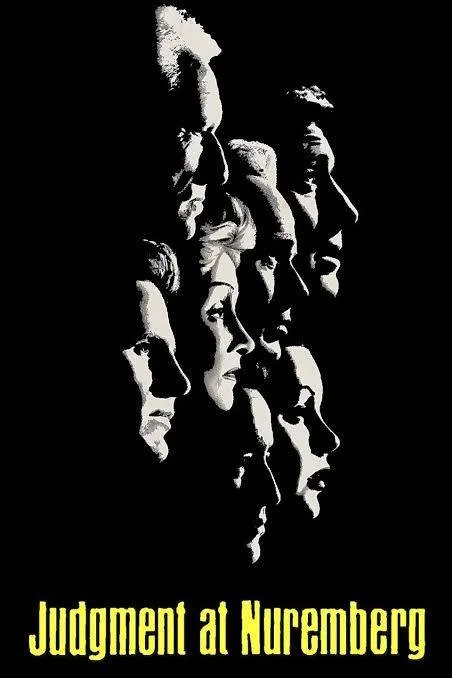
Starring: Spencer Tracey, Burt Lancaster, Judy Garland
Director: Stanley Kramer
🎬 Mise en Scène: Era Notes:
Year of Release: 1961
Cultural Context: Post–World War II America was confronting its own moral blind spots — McCarthyism, segregation, Cold War fear. A nation asking who gets to claim the moral high ground, and at what cost.
Era Peers: Paths of Glory, Inherit the Wind, To Kill a Mockingbird — courtroom dramas that wrestled with conscience and complicity.
The Vibe: Austere, humane, and quietly devastating. Faces become landscapes of guilt. Every silence echoes.
Why It Matters: A moral reckoning that refuses to age. Proof that “never again” is not a promise kept, but a promise tested.
🎬The Director’s Cut:
First Watch: Early 1980s, age approx. 6, with Nana
Rewatch: In the UK, alone, aged 49 (2025)
Scene that Still Gets Me: Judy Garland’s trembling, defiant testimony as Irene Wallner — a woman humiliated for an innocent act of kindness toward a Jewish man.
Will Be Remembered For: It’s unflinching spotlight on human abhorrence, and raising questions to which there are no easy answers.
Re:Cut Verdict: A searing moral reckoning that stares straight into humanity’s darkest mirror. Judgment at Nuremberg doesn’t just revisit history; it forces you to sit with it — the excuses, the silence, the unbearable weight of conscience that still echoes today. It’s also a mighty example of landmark cinema, with a landmark cast giving career-best performances.