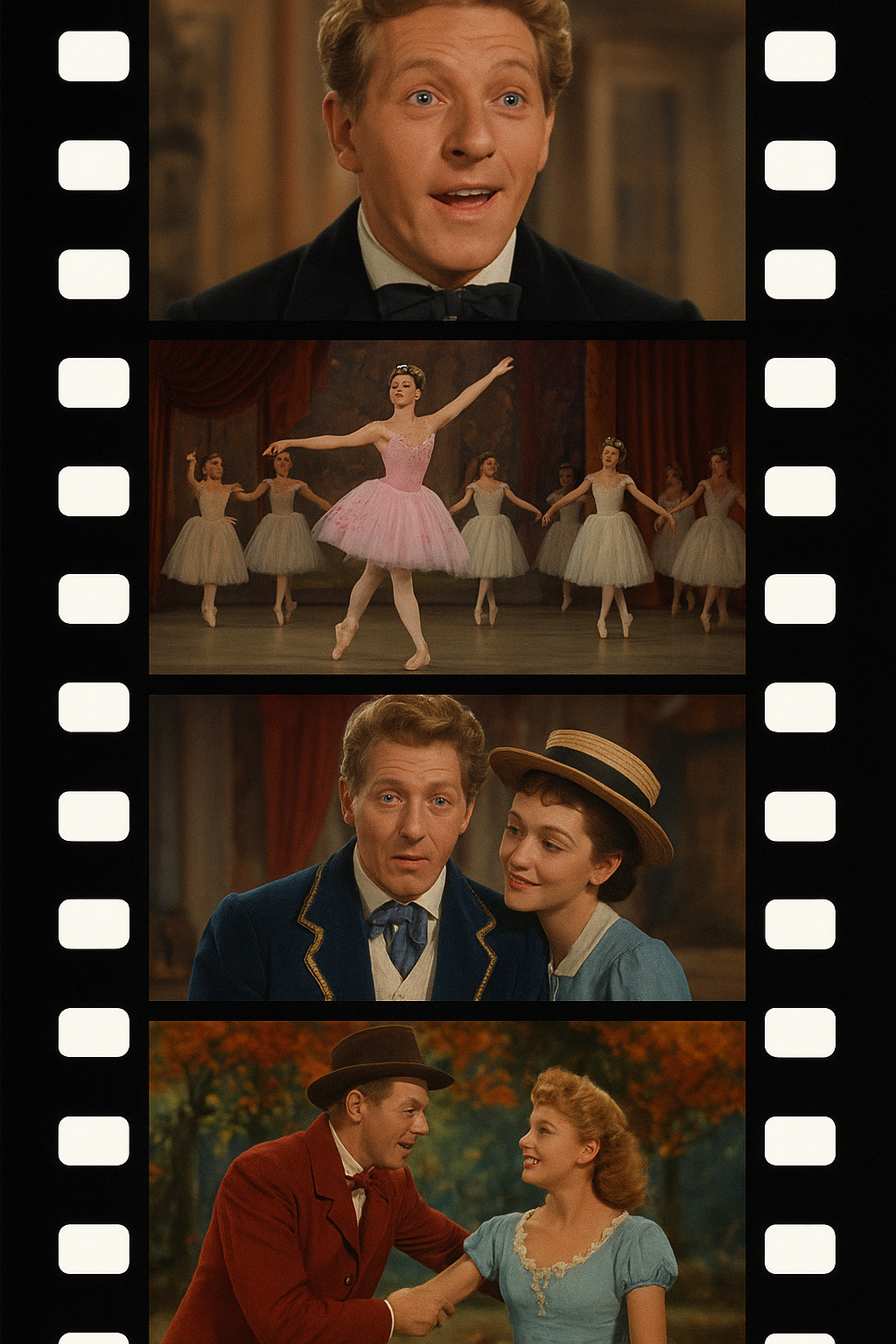
🎞️ Hans Christian Andersen (1952):
(Or, How I Learned to Stop Hiding and Paint My Pain in Technicolour)
The First Watch:
I don’t remember the first time I saw Hans Christian Andersen — not exactly. It just feels like it was always there, flickering somewhere in the background of my childhood, woven into the rhythm of endless afternoons at my Nana’s house (a major influence on my lifelong love of movies — more on that [here]).
We watched everything, but musicals were our favourite, and this one was stuck on repeat — both on the VHS and the record deck. I must’ve been five, old enough to follow the songs but too young to notice what was missing between the lines.
And that’s the thing about this film — it’s a fairytale about a man who wrote fairytales, made by a studio that didn’t believe children could handle pain. In Samuel Goldwyn’s candy-coloured Copenhagen, heartbreak is choreographed and despair flows in rhyming couplets. Danny Kaye, playing the dreamer cobbler with a child’s grin and a showman’s heart, isn’t the lonely, complicated Andersen of history. He’s something much softer, safer — a vessel for charm and optimism. And young me ate it up. I saw myself in him without even realising it - which explained the desire to watch it over and over again.
The real world was anything but pain-free. I was a sensitive, other-worldly kid who didn’t yet have words for trauma, or identity, or why I felt so different. There were also things happening to me that no child should endure - yet no-one would know for many years. And so, Danny Kaye became my first hero. Here was this man on screen — funny, warm, adored by all, unthreateningly flamboyant — living in a world where imagination solved everything. Where being different wasn’t dangerous; it was delightful. I adored him. I wanted to be him.
The Re:Watch:
I’ve seen this film countless times — but not for many years. The rewatch was a striking contrast to that scared and sensitive little boy watching on a tiny TV screen, a boy who didn’t yet know his place in the world. At 49, curled up in bed with my husband of 13 years and our 11-year-old cat in our home in Canada, watching in 4K on a 55-inch screen, my first feeling was pride, laced with melancholy. Life at five was terrifying. I was living in an abusive household (that’s a story for another post). Watching this movie snuggled up with Nana, listening to her softly singing along with “Thumbelina” as her chest rose and fell with the rhythm of her breathing, was quite literally an escape. Revisiting this beloved story as a fully self-realised adult, I had an overwhelming urge to reach back through time and whisper to that little boy, “Everything is going to be just fine.”
It’s also clear to me why, as a child, I was so enraptured by Danny Kaye. In the Hollywood of the 1950s, where masculinity came in two pre-approved flavours — rugged (Rory Calhoun) or tortured (James Dean) — Kaye was neither. He was something far rarer: bright, mercurial, and gloriously hard to pin down. A man who didn’t just step outside the mould; he seemed blissfully unaware that one existed.
On screen, he was always, unmistakably, Danny Kaye — nervous, endearing, endlessly kinetic. A chatterbox dreamer with a grin that could sell sunshine and eyes that always seemed a little too aware of the world’s sharp edges. He could sing, dance, clown, and charm, but when it came to romance — particularly the straight kind — he looked vaguely terrified. It wasn’t that he lacked chemistry with his leading ladies; it’s that he seemed to be playing a completely different genre. His real love affair was with whimsy, with joy itself.
Even his voice — that elastic, pattering instrument that could twist syllables into music — had an unashamedly camp lilt. There was something theatrical about him that I recognised long before I had a word for it, and on this rewatch, I realised how much of that coded energy had resonated even when I couldn’t name it. Later, I’d learn that Kaye was a deeply queer man living within the tight corset of 1950s Hollywood. But as a child, all I saw was someone who made difference look delightful.
While the rest of postwar America was busy rebuilding its idea of what a man should be — strong, stoic, silent — Kaye was twirling through the cracks, singing about ugly ducklings and inchworms. He wasn’t selling rebellion; he was offering permission. Permission to be odd. To be soft. To take up space with joy. I didn’t realise it then, but I was seeing a reflection of what I might become — not the man I was told to be, but the man I actually was.
The Re:View:
Even as nostalgia and melancholy swept over me, my inner film critic kicked in. As an adult, I can admit it’s a paper-thin film. It trades biography for fairytale, stitching together Andersen’s life and stories into something that’s all sugar and sparkle. Moss Hart’s script is shapeless and saccharine — a string of (admittedly iconic) songs hung on the barest clothesline of plot. It mistakes simplicity for innocence. Hans has no real arc; he just smiles through rejection and sings another song. A character built from good intentions and showtunes, and little else.
Yet it’s all so lovely. Frank Loesser’s score sparkles, Roland Petit’s choreography is exquisite, and when Renée Jeanmaire dances The Little Mermaid, the movie suddenly brushes against something transcendent — a flash of genuine longing and loss. For a few minutes, it remembers what Andersen’s stories were really about: the beautiful ache of wanting what you can’t have. And those songs — some of the most infectious, melodic, and captivating ever put to film. It’s the celluloid equivalent of a box of sugared marzipan.
Rewatching it now, I see what Goldwyn was doing — consciously or not. He wasn’t making a film about Andersen; he was making one for people like him. For dreamers who can’t bear the weight of their own sadness. For anyone who’s ever needed to paint their pain in Technicolor just to make it bearable.
The Re:Cut:
So no, Hans Christian Andersen doesn’t hold up as a biopic, or even as an especially honest story. But it holds me. It’s a window into who I was — a child who needed magic more than meaning. And it’s a mirror for who I am now — someone who understands that fantasy was never about escape; it was about survival.
I look at the world in 2025 with a kind of stunned sadness. I grew up in a time when progress felt like a one-way street — slow, imperfect, but steady. It wasn’t exactly easy being a gay kid in small-town northern England in the ’80s, but I watched things shift. Representation bloomed, tolerance turned into acceptance, and love — my kind of love — was finally recognised by law. For a while, it felt like we were moving somewhere better.
And then, almost overnight, the reel has started to run backwards. The rollback has been staggering. Authoritarian governments are once again policing identity, legislating expression, punishing difference. It’s as if we’ve forgotten that nonconformity isn’t a threat — it’s a form of creativity.
Safe spaces for children to simply be who they are aren’t just important; they’re vital. When I was growing up, movies were my safe space — a place where I could try on different selves and feel, for a couple of hours, like there was a world big enough for me in it. Now, as those spaces shrink in real life, I find myself coming back to film again — as reminder, refuge, and resistance. Because stories, at their best, have always done what good people do: they make room for the rest of us.
They’re also how we make sure the next generation doesn’t have to spend half a lifetime unlearning shame.
Starring: Danny Kaye, Renée Jeanmarie, Farley Granger
Director: Charles Vidor
🎬 Mise en Scène: Era Notes:
Year of Release: 1952
Studio: Samuel Goldwyn Productions
Cultural Context: America was basking in post-war optimism. Musicals were booming, offering joy and spectacle as a balm for a world newly out of conflict. Audiences craved charm, colour, and choreographed happiness.
Era Peers: Singin’ in the Rain (1952), An American in Paris (1951), The Band Wagon (1953), Calamity Jane (1953)
The Vibe: Technicolor fantasy, lavish ballets, catchy Loesser tunes. Every frame orchestrated for wonder.
Why It Matters: Understanding this era explains why Goldwyn’s Andersen is all polish and no melancholy — a deliberate, almost protective fantasy world for children and adults alike.
🎬The Director’s Cut:
First Watch: Early 1980s, VHS at Nana’s house
Rewatch: 2025, Canada, 4K HD
Scene that Still Gets Me: Jeanmaire’s Little Mermaid ballet
Will Be Remembered For: Being a shining example of Hollywood musical excess.
Re:Cut Verdict: A paean to a simpler time that also serves as a harsh reminder that progress isn’t necessarily linear. A movie that isn’t truth — but all comfort. And sometimes, that’s enough.